


ABA practice management KPIs help your team see where payments, documentation, and service delivery need attention. With payer transitions, reimbursement changes, and continued Medicaid oversight affecting providers, that visibility can make day-to-day decisions more informed.
The goal is to understand what is happening inside your practice, identify issues early, and give the right person enough information to respond.
Why Do ABA Practice Management KPIs Matter More Than Ever?
Tracking practice performance has always mattered. But payer changes and continued Medicaid scrutiny make it increasingly important to understand what is happening in your practice—and have the records to support it.
Providers need documentation that connects the care delivered with treatment plans, authorizations, and billed services. KPIs help teams identify missing information, unresolved reviews, and payment issues so they can investigate and follow up.
Recent industry developments show why that visibility matters:
- Payment uncertainty: Florida’s CMS Health Plan transitioned to Molina on October 1. Sunshine’s transition notice urged providers to check claims submission workflows. On October 23, CBS Miami reported provider payment complaints and an AHCA investigation.
- Continued audits: A February OIG report estimated at least $77.8 million in improper Colorado ABA payments for services delivered in 2022–2023.
- Reimbursement pressure: New York Medicaid reduced its fee-for-service rate for technician-delivered CPT 97153 services to $9.63 per unit, effective October 1.
- Changing authorization processes: Indiana ended peer-to-peer reviews for Traditional Medicaid prior authorization requests on November 1; administrative reviews and appeals remain available.
- Policy and oversight reviews: The CMS ABA Toolkit emphasizes individualized care and program integrity without creating new federal requirements. Florida’s ABA Task Force is also reviewing quality, authorization, and billing standards, with recommendations due December 31.
These developments differ in scope, but they raise a shared management question: can your team identify which services, records, and payments need follow-up?
A KPI is a measure selected to track an important practice goal. Useful ABA practice management KPIs pair a consistent calculation with an owner, a review schedule, and a defined response.
Payment and Billing KPIs You Should Monitor
Review these measures separately because each points to a different stage of the revenue cycle:
- Unbilled sessions: The number and age of completed visits awaiting billing, grouped by the unresolved step.
- Outstanding balances by payer and age: The amount remaining unpaid and how long those balances have been outstanding.
- Denial patterns: The number of denied claims and recurring denial reasons that need investigation.
For billed services, one useful calculation is:
Aged billed A/R percentage = Outstanding billed balance in the selected age group ÷ Total outstanding billed A/R × 100
The Healthcare Financial Management Association’s MAP Keys provides definitions for receivable aging and distinguishes billed balances from unbilled services. Choose a consistent aging basis and keep those categories separate.
Review denial reasons alongside unpaid balances. A claim awaiting processing needs a different response from one denied for an authorization issue. Grouping results by payer can help reveal where payment problems are concentrated, although the records still need investigation to establish the cause.
Documentation Metrics To Help You Identify Unresolved Issues
Documentation KPIs help your team locate incomplete work and recurring quality concerns:
- On-time documentation completion rate: The percentage of sessions documented by their applicable deadline.
- Notes pending QA: The number and age of notes awaiting review or approval.
- Unresolved corrections: The number of notes awaiting changes and how long those requests have been open.
For a reporting period, calculate:
On-time completion rate = Sessions documented by their applicable deadline ÷ Sessions whose documentation deadline has passed × 100
Define what “completed” means, including required signatures or approvals. This avoids comparing signed notes with notes that have only been drafted.
Then examine where work is accumulating. Notes awaiting provider corrections suggest a different bottleneck from completed notes awaiting reviewer approval.
Timeliness should be reviewed alongside quality. The BACB Ethics Code, Section 3.11, addresses documentation that supports service provision, accountability, and applicable requirements. A completion percentage helps locate work for review; it does not establish that the records meet every requirement.
KPIs To Help You Track Authorizations and Continuity of Care
Review measures that help your team anticipate deadlines and identify barriers to continued care:
- Pending authorization requests: The number of submitted requests awaiting a decision and their age.
- Unresolved renewals: The number of renewals with outstanding steps, grouped by approaching expiration date.
- Reassessment timelines: Upcoming and overdue reassessments, including those awaiting scheduling or completion.
- Authorization utilization: The percentage of authorized units used, reviewed by service code and authorization period.
Review individual stages so your team can distinguish work awaiting clinical input from submissions awaiting payer action. Assign each unresolved item a next step and an owner.
Authorization utilization can add context:
Authorization utilization = Used units ÷ Authorized units × 100
For example, 240 used units out of 400 authorized units equals 60%. That percentage means little without knowing the authorization dates, service code, treatment plan, and any interruptions. It should prompt review when appropriate, rather than become a universal target to maximize.
The purpose is to identify administrative barriers and support clinically appropriate care. The CMS Toolkit’s emphasis on individualized services makes clinical context particularly relevant to this review.
What Can Scheduling and Staffing Metrics Reveal?
Scheduling and staffing metrics help explain the gap between planned and delivered services:
- Service delivery rate: Completed sessions or hours divided by scheduled sessions or hours for the same period.
- Cancellation rate: Canceled sessions divided by scheduled sessions, multiplied by 100, with reasons reviewed separately.
- Upcoming credential expirations: The number of required credentials approaching expiration and the employees affected.
- Outstanding onboarding requirements: Incomplete items that may affect an employee’s readiness for upcoming assignments.
Define how rescheduled visits and no-shows are counted. If visits differ substantially in duration, review hours as well as session counts.
Separate family cancellations from practice-initiated cancellations. If missed visits are concentrated around certain times, the team may need to discuss scheduling options with families. If they coincide with staffing gaps, coverage may need attention.
Together, these measures help explain why a busy calendar may not translate into the expected level of delivered care.
How You Should Interpret ABA Practice Management KPIs and Set Priorities
Read related measures together before deciding what to change. If collections fall while completed visits remain stable, examine unbilled sessions and payer balances. If delivered services also decline, scheduling and staffing patterns deserve review.
Compare results with your practice’s historical performance using consistent definitions and reporting periods. When considering external benchmarks, check the population, payer mix, calculation, and age of the data before adopting a target.
Prioritize findings by their likely effect on care, approaching deadlines, and financial operations. Give each priority a responsible person and a follow-up date.
Also check whether an improvement creates another problem. The Institute for Healthcare Improvement recommends combining outcome, process, and balancing measures. For example, a faster documentation workflow should be reviewed alongside correction requests to understand whether quality is being maintained.
How Can ABA Matrix Support Ongoing KPI Reviews?
Custom Reports in ABA Matrix helps teams organize practice information around the questions they need to answer.
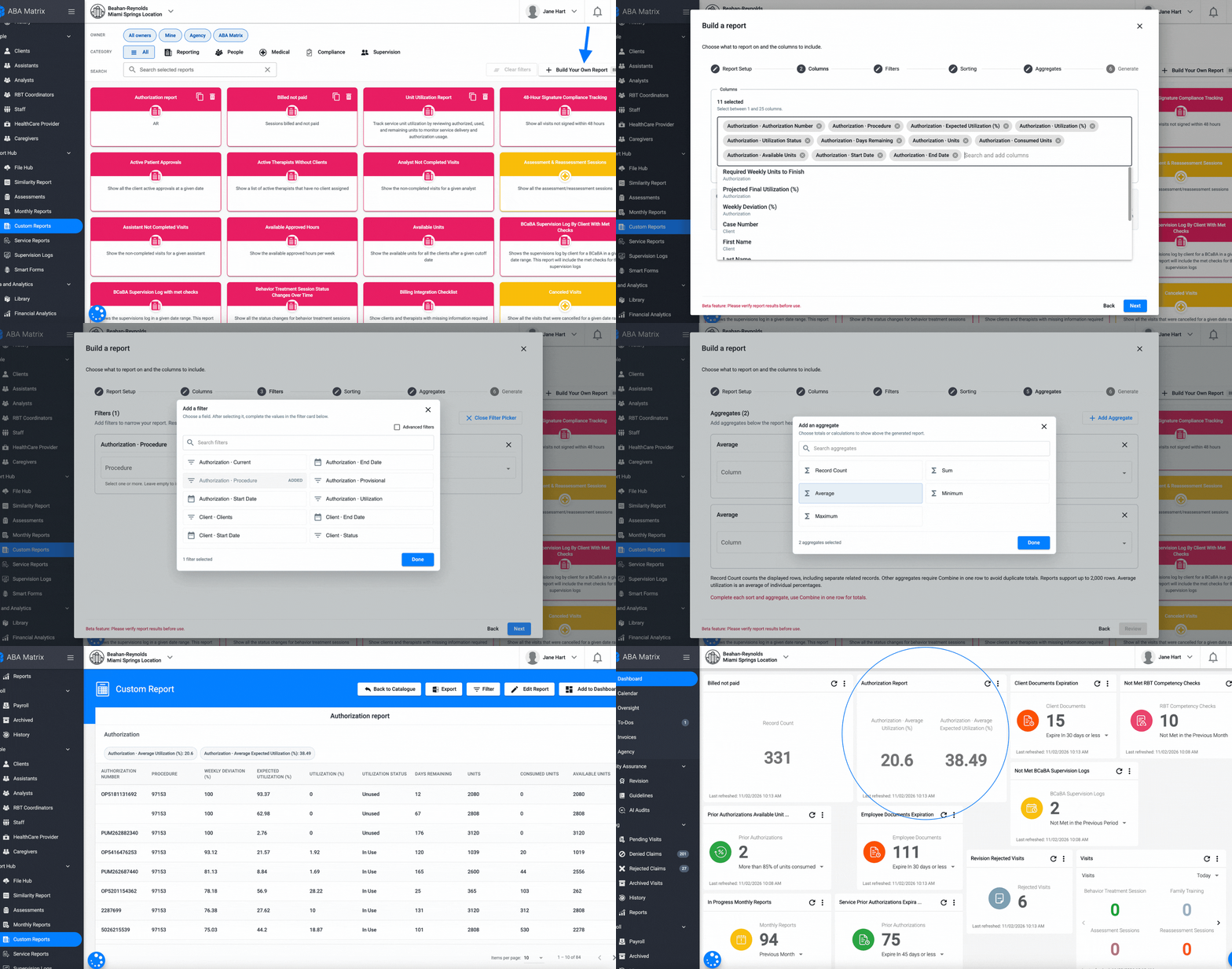
Users can customize an existing report or build their own, selecting columns, filters, sorting, and available calculations or aggregates. Reports can focus on items such as unpaid sessions, canceled visits, upcoming assessments, or authorization utilization.
Saved reports support repeat reviews, while Dashboard access keeps useful views within reach. Teams can also export reports for further analysis or follow-up.
A percentage can show that something changed; the underlying report helps your team identify which records to examine. Bringing both into a regular review process gives ABA practice management KPIs a practical role: helping people decide what to address and return to the results to see whether their response helped.