

Strong ABA therapy outcomes depend on more than clinical expertise and session data. They also depend on how well providers listen to and communicate with parents and caregivers. In many cases, caregiver concerns appear long before challenges are visible in data or formal reviews. That is why parent communication in ABA therapy plays such a critical role.
When communication is structured, consistent, and intentional, it becomes one of the most effective ways to identify concerns early, protect care quality, and strengthen caregiver trust.
For ABA practice owners and administrators, caregiver communication is not just a relationship skill. It is a quality assurance strategy.
Why Parent Communication in ABA Therapy Matters for Care Outcomes
Parent communication in ABA therapy directly influences how well treatment extends beyond sessions. Caregivers observe behaviors at home, notice changes in routines, and see how skills generalize in real-world environments. Their perspective provides context that clinical data alone cannot capture.
When caregivers feel heard and understood, they are more likely to stay engaged, follow recommendations, and collaborate with the care team. When communication breaks down, even effective clinical work can feel misaligned or incomplete.
Strong caregiver communication in ABA therapy supports better outcomes by creating shared understanding, aligning expectations, and reinforcing consistency across settings.
As BCBA Seam Yucum recently stated, “One of the biggest mistakes we can make as providers is not setting clear expectations with families from day one. ABA isn’t a drop-off service. It’s not a quick fix. And if parents/caregivers aren’t involved, the progress won’t last.”
How Parent Communication Helps Identify Caregiver Concerns Early
Caregiver concerns often surface through everyday communication. A comment about confusion, a question about progress, or a subtle expression of frustration can signal deeper issues that deserve attention.
Parent communication acts as an early indicator of care quality. When feedback is captured consistently, practices can recognize patterns before concerns escalate into dissatisfaction, disengagement, or service disruption.
The challenge is that many of these signals are easy to miss when communication is informal or undocumented. Without structure, valuable caregiver input may never reach leadership or be addressed in a timely way.
What Caregiver Concerns Commonly Surface
Through parent communication in ABA therapy, caregivers often raise concerns related to progress, communication frequency, consistency across staff, or how their child is responding to services. These concerns are not complaints by default. Most are requests for clarity, reassurance, or alignment.
Timing matters. Addressing these concerns early helps practices adjust expectations, clarify plans, and strengthen trust. When concerns go unaddressed, they can grow into larger issues that affect satisfaction and retention.
Why Informal Parent Communication Is Not Enough for Growing ABA Practices
Many ABA practices rely on verbal check-ins, emails, or ad hoc conversations to communicate with caregivers. While well-intentioned, these methods are difficult to scale and even harder to track.
Informal parent communication lacks consistency, documentation, and visibility. It depends heavily on individual staff members and does not always provide leadership with a clear view of caregiver experience across the organization.
As practices grow, caregiver communication solutions must evolve. Structure becomes essential for maintaining quality, consistency, and accountability.
How Structured Parent Communication Supports ABA Therapy Quality Assurance
From an operational perspective, caregiver communication is a powerful quality assurance tool. When feedback is collected in a standardized way, it becomes actionable data rather than isolated anecdotes.
Structured parent communication supports ABA therapy quality assurance by helping practices identify trends, document responsiveness, and demonstrate a commitment to continuous improvement. It also allows leadership teams to prioritize follow-up and allocate resources more effectively.
The goal is not to replace human connection, but to support it with systems that ensure no caregiver concern is overlooked.
What Parent Communication Solutions Look Like in Modern ABA Practices
Effective caregiver communication solutions share a few key characteristics. They are easy for caregivers to use, consistent across the organization, and meaningful for providers and administrators.
Modern solutions focus on capturing feedback in a way that is respectful, efficient, and actionable. They also support documentation and review without adding unnecessary administrative burden to clinical teams.
This is where technology can play a supportive role.
A Practical Solution: ABA Matrix’s Caregiver Acknowledgment & Feedback Form

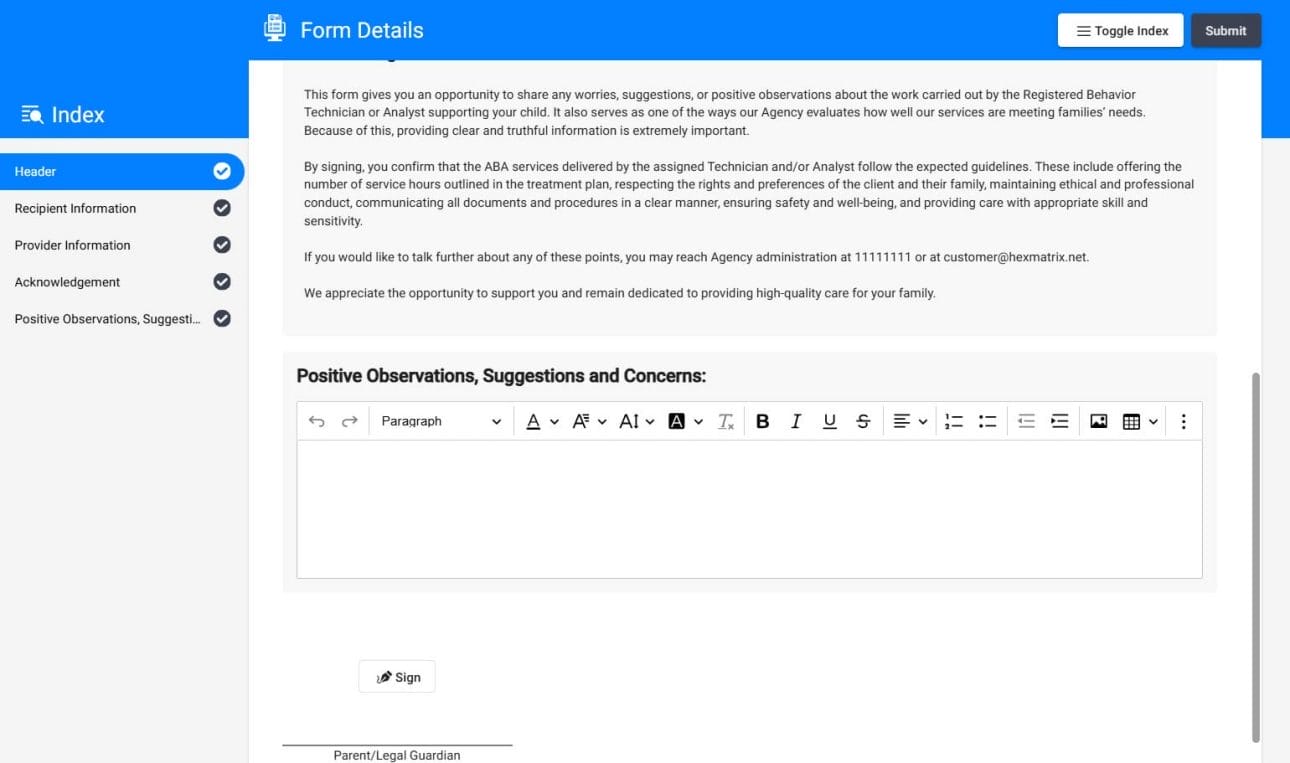
ABA Matrix offers the Caregiver Acknowledgment & Feedback tool, designed to support structured parent communication in ABA therapy. The form gives caregivers a clear and accessible way to share their experience after the provider sends it via email, and the system will notify the practice of the status of the email (whether it was sent and/or opened), and the form (whether it was opened, signed, and/or completed).
Parents or caregivers can submit positive observations, suggestions, and concerns in a single, centralized place. This creates a consistent feedback loop that supports transparency and trust.
For practices, the survey serves as a practical caregiver communication solution that improves visibility, documentation, and leadership oversight.
How AI Insights Strengthen Parent Communication and Follow-Up
What makes this solution especially powerful is the addition of AI Insights. These insights help practices move from collecting feedback to acting on it effectively.
Each caregiver response is reviewed and categorized based on overall sentiment. Reviews are classified as positive, neutral, mixed, or negative, giving immediate context to leadership teams.

AI Insights also indicate when follow-up may be recommended, helping ensure caregiver concerns do not go unnoticed. To support prioritization, each survey is assigned an urgency level, ranging from medium to critical, based on the content of the feedback.
In addition, the AI generates a summary that highlights key themes and issues. Each issue includes supporting evidence from the caregiver’s own words and a recommended area for review. A consolidated follow-up recommendation provides clear guidance on next steps.

These insights do not replace human judgment. Instead, they support faster, more informed decision-making.
How These Solutions Support ABA Therapy Quality Assurance
For ABA practice owners and administrators, structured parent communication combined with AI insights functions as a built-in quality assurance system. It supports early identification of concerns, improves caregiver satisfaction, and helps practices stay aligned with quality expectations.
By reviewing caregiver feedback consistently, leadership teams can address issues early, reinforce strengths, and demonstrate responsiveness. This approach helps practices stay ahead of potential risks while strengthening relationships with families.
FAQs: Parent Communication in ABA Therapy
Parent communication supports consistency, generalization, and alignment between caregivers and providers. It helps ensure therapy extends beyond sessions and reflects the child’s real-world needs.
Caregiver concerns often appear first through communication. Structured parent communication makes it easier to capture feedback early and respond before issues escalate.
Effective solutions are structured, consistent, and easy for caregivers to use. Surveys with built-in review tools and insights help practices manage feedback at scale.
Using standardized tools with automated insights allows practices to review feedback efficiently while maintaining strong caregiver relationships.
Better ABA Therapy Starts With Strong Parent Communication
Addressing caregiver concerns early requires more than good intentions. It requires systems that support consistent, meaningful communication. Parent communication in ABA therapy becomes most effective when it is structured, documented, and supported by practical solutions.
By combining thoughtful communication strategies with tools like ABA Matrix’s Caregiver Acknowledgment & Feedback Form, practices can strengthen quality assurance, improve caregiver satisfaction, and support better outcomes for the families they serve.